, to see if you have full access to this publication.
Monograph No access
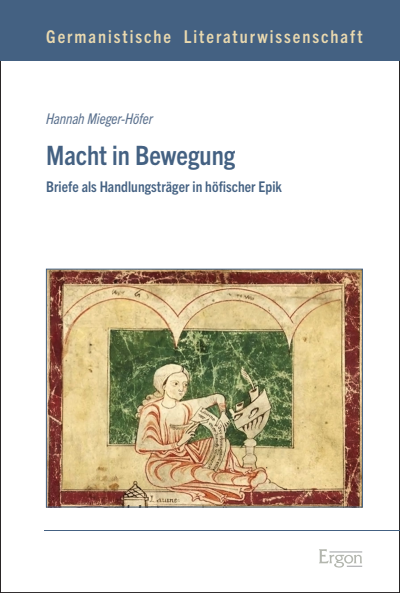
Macht in Bewegung
Briefe als Handlungsträger in höfischer Epik- Authors:
- Series:
- Germanistische Literaturwissenschaft, Volume 16
- Publisher:
- 2026
Summary
Letters are power in motion – this is illustrated in the present study by text-based analyses of letter scenes from four German-language novels of the Middle Ages. The author examines how the social and political significance of correspondence is constituted through material and performative aspects. As a means of communication, letters require persons who act on and with them, thus they always have a social component. Their creation is based on human interaction; they are usually actively transmitted and transported between people and places – their often powerful effect unfolds in motion.
Keywords
Search publication
Bibliographic data
- Edition
- 1/2026
- Copyright Year
- 2026
- ISBN-Print
- 978-3-98740-265-4
- ISBN-Online
- 978-3-98740-266-1
- Publisher
- Ergon, Baden-Baden
- Series
- Germanistische Literaturwissenschaft
- Volume
- 16
- Language
- German
- Pages
- 265
- Product Type
- Monograph
Table of contents
ChapterPages
- Danksagung No access
- 1.1 Materialität No access
- 1.2 Performanz No access
- 1.3 Macht No access
- 1.4 Textkorpus No access
- 2.1 Ein gefûchlicher Brief No access
- 2.2 Annäherungsversuch No access
- 2.3 Distanzüberwindung No access
- 2.4 Näheimagination No access
- 3.1 Sprechende Briefe No access
- 3.2.1 Othering als Narrativ No access
- 3.2.2 Belacane als Projektionsfläche No access
- 3.2.3 Brief als Abwesenheitszeichen No access
- 3.3 Selbstinszenierung: Ampflises Brief an Gahmuret No access
- 3.4.1 Botenqualität No access
- 3.4.2 Handschrift als Erkennungszeichen No access
- 3.4.3 Der Brief als Spiegel von Machtverhältnissen No access
- 3.5.1 Botenhierarchien No access
- 3.5.2 Botin als Garantie der Vergegenwärtigung No access
- 3.5.3 Brief als Beweis No access
- 3.6 Memoria-Stiftung: Feirefiz’ Brief No access
- 4.1 Mehrdimensionale Fernkommunikation in der Liebe und der Politik No access
- 4.2.1 Vertrauensvolle Nähe: Qualitätsmerkmale des Boten No access
- 4.2.2 Materiale Nähe: Der Brief als Vergegenwärtigungsmedium (Brief I) No access
- 4.2.3 Emotionale Nähe: Der Brief zur Offenbarung von Gefühlen (Brief I) No access
- 4.2.4 Stilistische Nähe: Kohärenzerzeugung mittels Isotopien (Brief I, II, III, IV) No access
- 4.2.5 Räumliche Nähe: Briefe konstituieren Räumlichkeit No access
- 4.2.6 Sprachliche und materiale Nähe trotz rechtmäßiger Distanz: Amalies Trennungsbrief (V) No access
- 4.2.7 Komplementäre Nähe: Parallelkommunikation von Brief und Botenbericht No access
- 4.2.8 Fazit: Inszenierung von Nähe No access
- 4.3.1 Materiale Machtdemonstration: Das Siegel No access
- 4.3.2 Sprachliche Machtdemonstration: Der Briefinhalt No access
- 4.3.3 Mehrteilige materiale Machtdemonstration: Zwei weitere Briefe No access
- 5.1 Multimediale Distanzkommunikation No access
- 5.2 Briefproduktion als Handlungsvorschau No access
- 5.3 Perspektive der höfischen Gesellschaft (Brief A) No access
- 5.4 Die Selbstunterordnung Beaflors (Brief B) No access
- 5.5 Distanzkommunikation als Vertrauensfrage No access
- 5.6 Vertrauensmissbrauch durch Machtposition No access
- 5.7 Wörtliche Wiedergabe als Spielraum für Fälschungen No access
- 5.8.1 Das Vertrauen auf den mündlichen Botenbericht No access
- 5.8.2 Die Macht der schriftlichen Briefberichte No access
- 5.9 Schrift als Medium der Ratio (Brief C) No access
- 5.10 Verantwortung und Schuld des Boten (Brief c) No access
- 5.11 Wirkungsmacht als narrativer Höhepunkt No access
- 5.12 Handschrift als Wahrheitsbeweis No access
- 5.13 Bewegtsein durch wortgetreue Blendung No access
- 6.1 Private und politische Briefe No access
- 6.2 Bewegte und bewegende Briefe No access
- 6.3 Vergegenwärtigende Briefe No access
- 6.4 Machtvolle Briefe No access
- 7.1 Lexika und Nachschlagewerke No access
- 7.2 Primärliteratur No access
- 7.3 Sekundärliteratur No access